
Culture
Ciara becomes citizen of Benin under landmark law for slave descendants
The R&B star received her citizenship during a ceremony in Cotonou, becoming one of the first public figures to benefit from the initiative.



Grammy-winning singer Ciara has officially become a citizen of Benin, marking a historic moment under the West African nation’s new law offering citizenship to descendants of enslaved Africans. The R&B star received her citizenship during a ceremony in Cotonou, becoming one of the first public figures to benefit from the initiative.
Ciara receives Benin citizenship
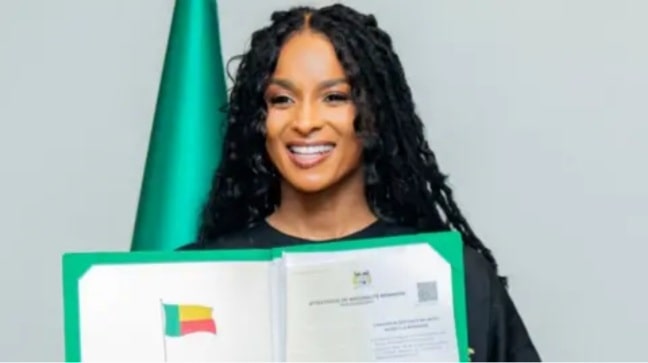
Credit: Benin Government
In a heartfelt Instagram post, Ciara expressed gratitude, writing, “Thank you Benin for opening your arms and your heart to me. Je suis Béninoise.” Her message resonated widely, underscoring the emotional significance of the moment.
A Symbolic Return to Roots
Benin’s government released a statement, describing the act as “a gesture of the soul, a return to one’s roots.”
“By legally recognizing these children of Africa, Benin is healing a historical wound. It is an act of justice, but also one of belonging and hope”.
My Afro Origins Law
The citizenship law, known as the My Afro Origins Law, was enacted in September 2024. It allows individuals over 18 who can trace their ancestry to the transatlantic slave trade to apply for citizenship. Applicants must not hold another African nationality and can submit DNA tests, verified family records, or sworn testimonies as proof.
Connecting the Diaspora
Benin’s initiative is part of a broader effort to reconcile with its role in the slave trade and foster stronger ties with the global Black diaspora. Between the 16th and 18th centuries, the Kingdom of Whydah—located on Benin’s coast—was a major slave-trading hub. An estimated 1.5 million Africans were deported from the Bight of Benin to the Americas.
Unlike many nations, Benin has openly acknowledged its complicity. In 1999, then-President Mathieu Kérékou publicly apologized to African Americans during a visit to Baltimore. Today, the country continues to invest in “memorial tourism,” with sites like the Slave Route and the Door of No Return in Ouidah offering powerful spaces for reflection and education.
Cultural Ambassadors and Tourism Boost
Just days before Ciara’s ceremony, Benin appointed filmmaker Spike Lee and author Tonya Lewis Lee as ambassadors to African Americans in the U.S., further signaling its commitment to cultural diplomacy and historical reckoning.
Following her citizenship ceremony, Ciara toured Ouidah’s memorial sites, walking the Slave Route to the Door of No Return. Her visit, filled with emotion and reflection, highlighted the personal and collective significance of reconnecting with ancestral heritage.
Digital Access to Citizenship
To streamline applications, Benin launched the My Afro Origins platform, allowing descendants worldwide to begin their journey toward citizenship. The move positions Benin as a leader in diaspora engagement and historical reconciliation.
As Ciara’s story continues to inspire, Benin’s bold initiative offers a blueprint for healing, belonging, and cultural restoration—one citizen at a time.
Real stories. Real impact. Straight to your inbox. Join thousands others. Click here to subscribe to our newsletter today!
Follow us on Facebook, X, TikTok, Instagram












Memphis man sues city, police over photo taken of his deceased mother

Asbury Park High School: History Seminar

New Jersey police reach $4 million settlement with children of woman killed by ex-husband, a former police officer

Druski new parody mocking conservative women sparks debate

Detroit man convicted of sexually assaulting, killing teen found dead in prison 2 weeks after sentencing
Kendrick Johnson’s parents file $10B lawsuit against federal judges

GoFundMe launched after Alabama mother is fatally shot by husband hours after giving birth

Shaquille O’Neal pays for funeral costs for 12‑year‑old Jada West, Georgia officials say

Family demands justice after Baltimore County man dies after being punched by police officer in violent encounter
New Jersey police reach $4 million settlement with children of woman killed by ex-husband, a former police officer

OWN greenlights first-ever ‘Belle Collective’ spinoff Belle Collective: Birmingham

Hazel Scott’s legacy returns to Harlem in free outdoor film screening

Olympic Gymnast Frederick Richard sets world record, raises $50K for Ugandan youth

Renee Ferguson, trailblazing investigative journalist, dies at 75

“AfroPoP Digital Shorts” returns to the land with “Sweet Samara,” climate and abolitionist film




-
 Community2 weeks ago
Shaquille O’Neal pays for funeral costs for 12‑year‑old Jada West, Georgia officials say
-
 Social Justice3 days ago
New Jersey police reach $4 million settlement with children of woman killed by ex-husband, a former police officer
-
 Education1 week ago
Asbury Park High School: Crossover event esports and history with Tina Watson
-
 Social Justice5 days ago
Jury awards California woman $15 million after supervisor called her n-word
-

 Culture2 weeks ago
Wu‑Tang Clan concert film to screen at The Pinhook as part of Wu‑Tang Wednesday Series
-
 Social Justice7 days ago
Family pleads for Trump’s help bringing severely ill son home from Chinese prison
-
 Crime & Justice4 days ago
Detroit man convicted of sexually assaulting, killing teen found dead in prison 2 weeks after sentencing
-
 Culture3 days ago
Druski new parody mocking conservative women sparks debate
-
 Social Justice2 weeks ago
DOJ moves to dismiss criminal case against ex-officers charged for role in Breonna Taylor’s death
-

 In Memoriam2 weeks ago
In Memoriam: Beloved Showtime at the Apollo co-host Kiki Shepard