
Social Justice
Legal Defense Fund defends majority-Black district in Supreme court case
The case, Louisiana v. Callais, could reshape how race factors into redistricting nanationwide.

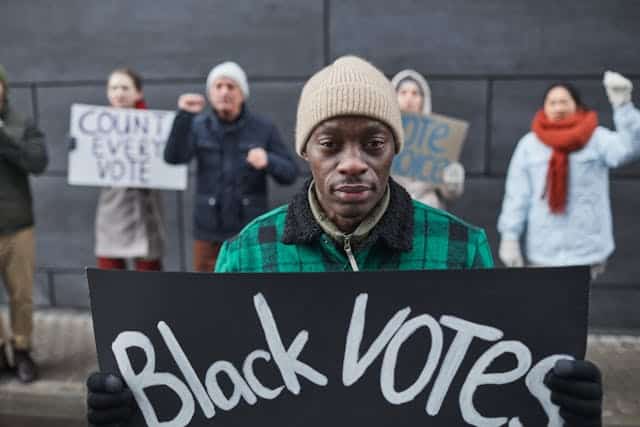

WASHINGTON — The U.S. Supreme Court heard oral arguments last week in Louisiana v. Callais, a case that could dismantle key protections under the Voting Rights Act of 1965 and reshape political representation across the country. Legal Defense Fund President Janai Nelson defended Louisiana’s 2024 congressional map, which includes a second majority-Black district, against claims of unconstitutional racial gerrymandering.
Louisiana v. Callais : Louisiana’s 2024 congressional map
The case stems from Louisiana’s 2020 redistricting process. Despite Black residents making up nearly one-third of the state’s population, lawmakers drew maps that allowed them to elect only one of six congressional representatives. Lower courts found this violated Section 2 of the VRA, which prohibits voting policies that dilute minority voting power.
In response, the legislature revised the map to include a second majority-Black district—while still preserving partisan objectives. A group of white voters challenged the new map, arguing that ensuring representation for Black voters amounted to racial discrimination against white voters.
Nelson defended the map as consistent with constitutional and Voting Rights Act requirements, according to the Legal Defense Fund’s public statements.
The stakes are high. A ruling against the map could gut what remains of the VRA, enabling more extreme partisan gerrymandering and threatening districts held by Democratic officials—many of whom are people of color. Advocates warn that such a decision would echo the rollback of civil rights protections seen after the Court’s 2013 Shelby County v. Holder ruling.
History of Louisiana v. Callais
The roots of Louisiana v. Callais trace back to Reconstruction, when the U.S. attempted to integrate formerly enslaved Black Americans into the political system. That effort faced fierce resistance then—and faces renewed threats now.
A decision is expected later this term. Until then, the future of fair representation hangs in the balance.
Real stories. Real impact. Straight to your inbox. Join thousands others. Click here to subscribe to our newsletter today!
Follow us on Facebook, X, TikTok, Instagram











Virgin Islands announces lineup for 74th annual St. Thomas Carnival Village

Memphis man sues city, police over photo taken of his deceased mother

Asbury Park High School: History Seminar

New Jersey police reach $4 million settlement with children of woman killed by ex-husband, a former police officer

Druski new parody mocking conservative women sparks debate

Kendrick Johnson’s parents file $10B lawsuit against federal judges

Shaquille O’Neal pays for funeral costs for 12‑year‑old Jada West, Georgia officials say

GoFundMe launched after Alabama mother is fatally shot by husband hours after giving birth

Family demands justice after Baltimore County man dies after being punched by police officer in violent encounter
New Jersey police reach $4 million settlement with children of woman killed by ex-husband, a former police officer

OWN greenlights first-ever ‘Belle Collective’ spinoff Belle Collective: Birmingham

Hazel Scott’s legacy returns to Harlem in free outdoor film screening

Olympic Gymnast Frederick Richard sets world record, raises $50K for Ugandan youth

Renee Ferguson, trailblazing investigative journalist, dies at 75

“AfroPoP Digital Shorts” returns to the land with “Sweet Samara,” climate and abolitionist film




-
 Community2 weeks ago
Shaquille O’Neal pays for funeral costs for 12‑year‑old Jada West, Georgia officials say
-
 Social Justice3 days ago
New Jersey police reach $4 million settlement with children of woman killed by ex-husband, a former police officer
-

 Education1 week ago
Asbury Park High School: Crossover event esports and history with Tina Watson
-
 Social Justice5 days ago
Jury awards California woman $15 million after supervisor called her n-word
-

 Culture2 weeks ago
Wu‑Tang Clan concert film to screen at The Pinhook as part of Wu‑Tang Wednesday Series
-
 Social Justice1 week ago
Family pleads for Trump’s help bringing severely ill son home from Chinese prison
-

 Crime & Justice4 days ago
Detroit man convicted of sexually assaulting, killing teen found dead in prison 2 weeks after sentencing
-
 Culture3 days ago
Druski new parody mocking conservative women sparks debate
-
 Social Justice2 weeks ago
DOJ moves to dismiss criminal case against ex-officers charged for role in Breonna Taylor’s death
-

 In Memoriam2 weeks ago
In Memoriam: Beloved Showtime at the Apollo co-host Kiki Shepard