
In Memoriam
George Hardy, one of the last of the Tuskegee Airmen, dies at 100
Hardy was the youngest Red Tail fighter pilot to fly a combat mission over Europe, according to Tuskegee Airmen, Inc. National Office.

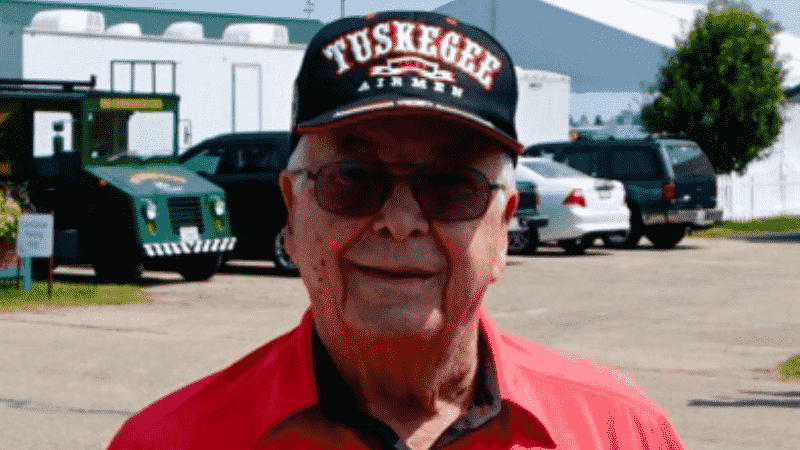

Lt. Col. George Hardy, one of the last orginial Tuskegee Airmen combat pilots, passed away Thursday.
He was 100.
Remembering youngest Tuskegee Airman Lt. Col. George Hardy
Hardy was the youngest Red Tail fighter pilot to fly a combat mission over Europe, according to Tuskegee Airmen, Inc. National Office.
At just 19, he flew his first sortie in a P-51 Mustang during World War II. He completed 21 missions.
Hardy was the last living Tuskegee Airman to see combat. Thirteen others trained at Tuskegee but never deployed.
“His legacy is one of courage, resilience, tremendous skill and dogged perseverance against racism, prejudice and other evils. We are forever grateful for his sacrifice and will hold dear to his memory,” the organization wrote in a post announcing Hardy’s death. “Our condolences to his family, friends, the remaining 13 Documented Original Tuskegee Airmen, and all who loved him.”
His legacy as a pioneering pilot
His military journey began after the attack on Pearl Harbor, six months before he graduated high school.
Initially, Hardy hadn’t considered a military career. But the war and racism changed everything.
“A lot of people don’t realize how segregated the service was then,” Hardy said in an interview with WUSA9.
He referenced the Army War College’s 1925 report, which falsely claimed Black Americans lacked the capacity to fly.
“They thought we couldn’t concentrate or handle danger,” Hardy said. “We disproved that theory. We did a hell of a good job.”
Throughout his 90s, Hardy remained active. He volunteered at food pantries and spoke nationwide about Tuskegee’s legacy.
Hardy urged Americans to learn about the Tuskegee Airmen. “Too many people still don’t know,” he said.
“Servicemen gave their all,” Hardy added. “Many didn’t come back. We should pay tribute to them.”
Tuskegee Airmen: Breaking Barriers in World War II
During World War II, the U.S. military remained racially segregated. To challenge racial bias, leaders launched the Tuskegee Experiment, a groundbreaking initiative to determine if Black Americans could successfully pilot and maintain combat aircraft.
Nearly 1,000 Black aviators completed rigorous flight training and earned military commissions. Over 300 Tuskegee Airmen deployed overseas, flying missions with skill and courage. Thousands more including women served in critical support roles. These trailblazers helped prove that Black service members could excel in complex military operations.
Their success paved the way for desegregation in the armed forces. The Tuskegee Airmen earned national respect and military honors.
Today, only 13 Documented Original Tuskegee Airmen are still alive. Tuskegee Airmen, Inc., founded in 1975, works to preserve their legacy and educate future generations.
Real stories. Real impact. Straight to your inbox. Join thousands others. Click here to subscribe to our newsletter today!
Follow us on Facebook, X, TikTok, Instagram








Virgin Islands announces lineup for 74th annual St. Thomas Carnival Village

Memphis man sues city, police over photo taken of his deceased mother

Asbury Park High School: History Seminar

New Jersey police reach $4 million settlement with children of woman killed by ex-husband, a former police officer

Druski new parody mocking conservative women sparks debate

Shaquille O’Neal pays for funeral costs for 12‑year‑old Jada West, Georgia officials say

Kendrick Johnson’s parents file $10B lawsuit against federal judges

GoFundMe launched after Alabama mother is fatally shot by husband hours after giving birth

Family demands justice after Baltimore County man dies after being punched by police officer in violent encounter
New Jersey police reach $4 million settlement with children of woman killed by ex-husband, a former police officer

OWN greenlights first-ever ‘Belle Collective’ spinoff Belle Collective: Birmingham

Hazel Scott’s legacy returns to Harlem in free outdoor film screening

Olympic Gymnast Frederick Richard sets world record, raises $50K for Ugandan youth

Renee Ferguson, trailblazing investigative journalist, dies at 75

“AfroPoP Digital Shorts” returns to the land with “Sweet Samara,” climate and abolitionist film




-
 Community2 weeks ago
Shaquille O’Neal pays for funeral costs for 12‑year‑old Jada West, Georgia officials say
-
 Social Justice5 days ago
New Jersey police reach $4 million settlement with children of woman killed by ex-husband, a former police officer
-

 Education1 week ago
Asbury Park High School: Crossover event esports and history with Tina Watson
-

 Social Justice7 days ago
Jury awards California woman $15 million after supervisor called her n-word
-

 Social Justice1 week ago
Family pleads for Trump’s help bringing severely ill son home from Chinese prison
-

 Crime & Justice6 days ago
Detroit man convicted of sexually assaulting, killing teen found dead in prison 2 weeks after sentencing
-
 Culture5 days ago
Druski new parody mocking conservative women sparks debate
-

 In Memoriam2 weeks ago
In Memoriam: Beloved Showtime at the Apollo co-host Kiki Shepard
-
 Social Justice2 weeks ago
DOJ moves to dismiss criminal case against ex-officers charged for role in Breonna Taylor’s death
-
 Police3 days ago
Memphis man sues city, police over photo taken of his deceased mother