
Culture
Target faces renewed backlash over offensive Halloween costume with ‘Minstrel Show Features’
Target is facing renewed backlash after selling a children’s Halloween costume that critics say included “minstrel show features.



Target is facing renewed backlash after selling a children’s Halloween costume that critics say included “minstrel show features,” prompting the retailer to pull the item and open an internal review.
A “Halloween” Costume Sparks National Outcry
The listing showed a Black child wearing an orange‑and‑black clown suit, gloves, a top hat and a wide, exaggerated mask. Many critics said the custome resembled Jim Crow‑era caricatures used to mock Black Americans and echoed minstrel‑show stereotypes.
The costume, sold as the “Kids’ Glows Under Blacklight Circus Clown Halloween Costume,” spread quickly online prompting outrage over Target’s poor decision.
Target Apologizes and Removes the Costume
Target apologized and said the costume “should never have been part of our assortment.” The company acknowledged the harm caused to Black customers and employees and said it is reviewing its approval process. The retailer also said it is evaluating how the costume passed internal checks. Furthermore, why concerns were not flagged earlier.
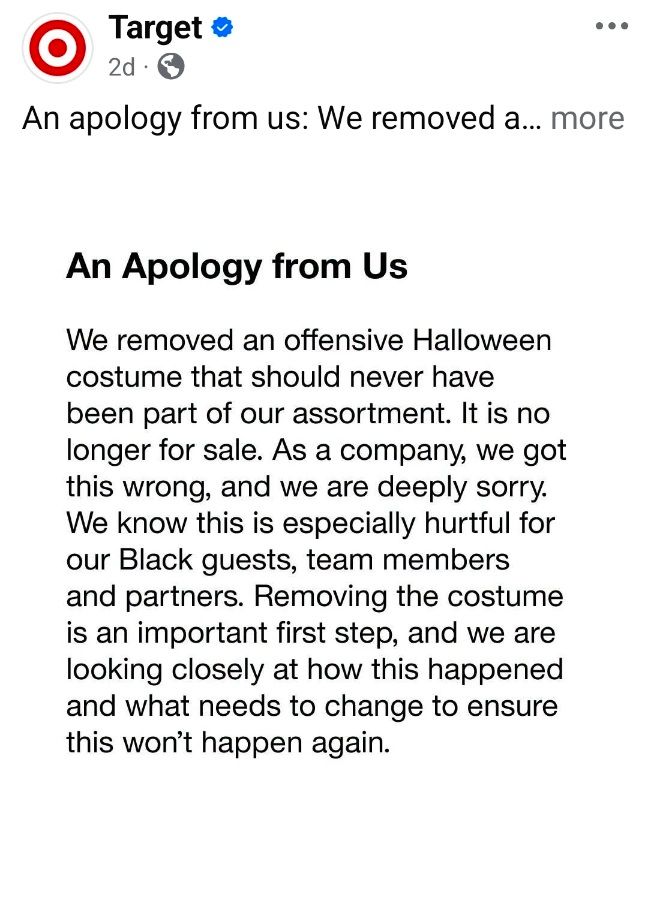
Target’s apology on Facebook
DEI
The apology comes at a time of heightened scrutiny for the retailer. In 2025, Target scaled back several diversity, equity and inclusion programs, replacing them with a narrower “Belonging” initiative. Critics say this DEI shift weakened internal oversight. Moreover, allowed racially insensitive products to move through the approval process.
The incident also comes as Target tries to stabilize sales and rebuild trust with Black shoppers after rolling back those DEI commitments, a decision that fueled a yearlong boycott.
Backlash Grows as Questions Mount
The controversy has drawn national attention and sparked broad discussion on race. Many said the costume’s imagery revived painful historical associations and showed how easily racist tropes can resurface, even in commercial products.
Viola Davis
One who publically vocalized their dissatisfaction was actress Viola Davis. In a social media post, Davis said she does not accept Target’s apology, saying the company failed to understand the historical weight of minstrel‑style imagery.
She wrote, “I do not accept your apology, and I do not believe that you understand the impact… the pain… the dehumanization of the above.” She added that the imagery “laid the foundation for atrocities committed against Black people,” and concluded, “You have shown us that you are not on OUR side.”
Historical Context Matters
The costume clearing multiple approval layers and reaching store shelves underscores why teaching and understanding history matters.
Minstrel imagery, commonly known as Blackface, has long been recognized as a degrading caricature used to justify discrimination. The costume’s exaggerated smile and styling resembled tropes found in 19th‑century sheet music, advertisements and stage performances. Historians note that these depictions shaped public attitudes and reinforced racist narratives for generations.
The controversy shows how quickly harm can resurface when cultural awareness breaks down, and why historical literacy should never be optional. Because Blackface has no place on Halloween or anywhere for that matter.
Blackface has no place on Halloween or anywhere for that matter
Discover more from Unheard Voices Magazine®
Subscribe to get the latest posts sent to your email.











Happy Birthday! Opal Lee, known as the “Grandmother of Juneteenth”, turns 100

Buried history: Documentary uncovers Black slave cemetery hidden under Staten Island shopping center

Justice for Nolan Wells Reward Fund raises $300k

NYPD makes arrest 8 months after Kianna Underwood’s fatal hit‑and‑run

In Memoriam: R&B legend Freddie Jackson dies at 70

Strangers raise $10,000 in 48 hours for Las Vegas piano tuner after viral video

VP of Detroit funeral home found dead days after family said mother was mistakenly cremated

Kitchen + Kocktails by Kevin Kelley to open 10,000‑square‑foot Times Square restaurant on Oct. 3

Black Public Media opens submissions for 10th PitchBLACK, offering filmmakers up to $150,000 in production funding

Black Aerospace Professionals Development Director Haifa Baptiste dies in Costa Rica flash flood

Woody Shaw’s Avant‑Garde ‘Song of Songs’ returns to vinyl after 50 years through Jazz Dispensary’s Top Shelf Series

Kansas City’s Copper Boyz Ranch provides youth violence‑prevention through horsemanship

Nolan Wells’ family demands ‘thorough’ investigation: “What we’ve been told does not make sense”

Peabo Bryson, Grammy‑winning voice behind two Disney classics, dies at 75

OWN greenlights first-ever ‘Belle Collective’ spinoff Belle Collective: Birmingham





-
 In Memoriam2 weeks ago
VP of Detroit funeral home found dead days after family said mother was mistakenly cremated
-

 Health & Wellness2 weeks ago
California couple welcomes rare mixed triplets weighing 19 pounds total, nearly breaking world record
-

 In Memoriam2 weeks ago
North Carolina A&T mourns beloved senior who tragically died after saving sister from drowning
-

 Social Justice2 weeks ago
White Philadelphia teacher and activist admits to lying about being Black and Palestinian
-

 Real Voices2 weeks ago
Beloved College of San Mateo football player Ja’Marion “Pop” Grace killed in car crash
-
 Culture2 days ago
Buried history: Documentary uncovers Black slave cemetery hidden under Staten Island shopping center
-

 Social Justice2 weeks ago
Texas woman once sentenced to five years for a voting mistake has her acquittal upheld
-
 Social Justice4 days ago
Atlanta University Center students marched to demand justice for Nolan Wells