
In Memoriam
George Hardy, one of the last of the Tuskegee Airmen, dies at 100
Hardy was the youngest Red Tail fighter pilot to fly a combat mission over Europe, according to Tuskegee Airmen, Inc. National Office.

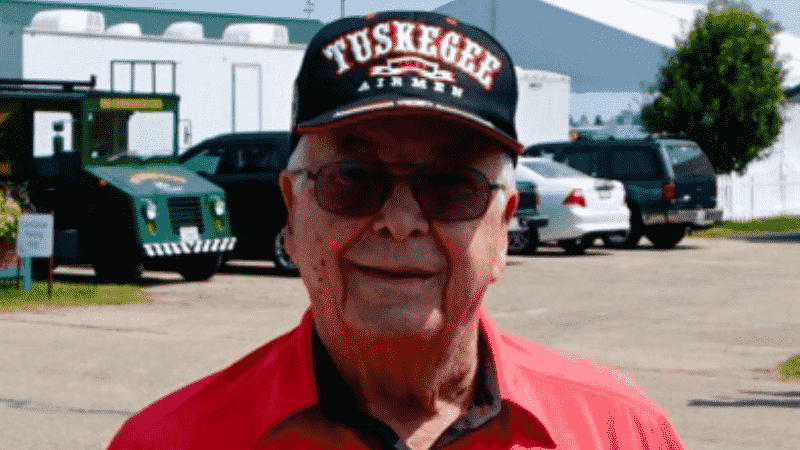

Lt. Col. George Hardy, one of the last orginial Tuskegee Airmen combat pilots, passed away Thursday.
He was 100.
Remembering youngest Tuskegee Airman Lt. Col. George Hardy
Hardy was the youngest Red Tail fighter pilot to fly a combat mission over Europe, according to Tuskegee Airmen, Inc. National Office.
At just 19, he flew his first sortie in a P-51 Mustang during World War II. He completed 21 missions.
Hardy was the last living Tuskegee Airman to see combat. Thirteen others trained at Tuskegee but never deployed.
“His legacy is one of courage, resilience, tremendous skill and dogged perseverance against racism, prejudice and other evils. We are forever grateful for his sacrifice and will hold dear to his memory,” the organization wrote in a post announcing Hardy’s death. “Our condolences to his family, friends, the remaining 13 Documented Original Tuskegee Airmen, and all who loved him.”
His legacy as a pioneering pilot
His military journey began after the attack on Pearl Harbor, six months before he graduated high school.
Initially, Hardy hadn’t considered a military career. But the war and racism changed everything.
“A lot of people don’t realize how segregated the service was then,” Hardy said in an interview with WUSA9.
He referenced the Army War College’s 1925 report, which falsely claimed Black Americans lacked the capacity to fly.
“They thought we couldn’t concentrate or handle danger,” Hardy said. “We disproved that theory. We did a hell of a good job.”
Throughout his 90s, Hardy remained active. He volunteered at food pantries and spoke nationwide about Tuskegee’s legacy.
Hardy urged Americans to learn about the Tuskegee Airmen. “Too many people still don’t know,” he said.
“Servicemen gave their all,” Hardy added. “Many didn’t come back. We should pay tribute to them.”
Tuskegee Airmen: Breaking Barriers in World War II
During World War II, the U.S. military remained racially segregated. To challenge racial bias, leaders launched the Tuskegee Experiment, a groundbreaking initiative to determine if Black Americans could successfully pilot and maintain combat aircraft.
Nearly 1,000 Black aviators completed rigorous flight training and earned military commissions. Over 300 Tuskegee Airmen deployed overseas, flying missions with skill and courage. Thousands more including women served in critical support roles. These trailblazers helped prove that Black service members could excel in complex military operations.
Their success paved the way for desegregation in the armed forces. The Tuskegee Airmen earned national respect and military honors.
Today, only 13 Documented Original Tuskegee Airmen are still alive. Tuskegee Airmen, Inc., founded in 1975, works to preserve their legacy and educate future generations.
Discover more from Unheard Voices Magazine®
Subscribe to get the latest posts sent to your email.














NAACP launches National Black Man Voter Day with week of action aimed at mobilizing 100,000 Black men

Former NFL defensive end Allen Bailey dies at 37

University of Maryland Tennis Club issues public apology after racist imagery sparks backlash

Mississippi Attorney General says officer was justified in shooting that killed 1‑year‑old Kohen Wiley

Police veteran begins rare cancer fight after pleomorphic sarcoma diagnosis

VP of Detroit funeral home found dead days after family said mother was mistakenly cremated

Black Aerospace Professionals Development Director Haifa Baptiste dies in Costa Rica flash flood

Mississippi police make second arrest in death of Black woman found hanging from tree

Justice for Nolan Wells Reward Fund raises $300k

California couple welcomes rare mixed triplets weighing 19 pounds total, nearly breaking world record

Woody Shaw’s Avant‑Garde ‘Song of Songs’ returns to vinyl after 50 years through Jazz Dispensary’s Top Shelf Series

Kansas City’s Copper Boyz Ranch provides youth violence‑prevention through horsemanship

Nolan Wells’ family demands ‘thorough’ investigation: “What we’ve been told does not make sense”

Peabo Bryson, Grammy‑winning voice behind two Disney classics, dies at 75

OWN greenlights first-ever ‘Belle Collective’ spinoff Belle Collective: Birmingham





-

 In Memoriam2 weeks ago
Boston rapper Rahim “V Knuckles” Muhammad dies at 46 after fight with brain cancer
-
 In Memoriam2 weeks ago
Major Jewel McDonald, oldest known living man in the U.S., dies at 110
-

 In Memoriam2 weeks ago
Curtis Flowers, Mississippi man wrongfully convicted after being tried for the same killings 6 times, dies at 56
-

 New Jersey2 weeks ago
New Jersey mom demands answers after 4‑year‑old son died at daycare
-

 Real Voices2 weeks ago
Woman dies after stopping to help trapped driver of flipped car on interstate
-

 Health & Wellness2 weeks ago
Teen brother to donate lifesaving bone marrow to younger sister battling sickle cell
-
 Culture2 weeks ago
Black Public Media to premiere “The Morgue Twins,” spotlighting twin NYC mortuary technicians
-

 Police2 weeks ago
Dr. Anita Allen makes history as the first Black woman police chief in a Metro Atlanta city