
Police
Here are America’s worst police departments
According to a social study, almost nearly half of American’s hate their police department.

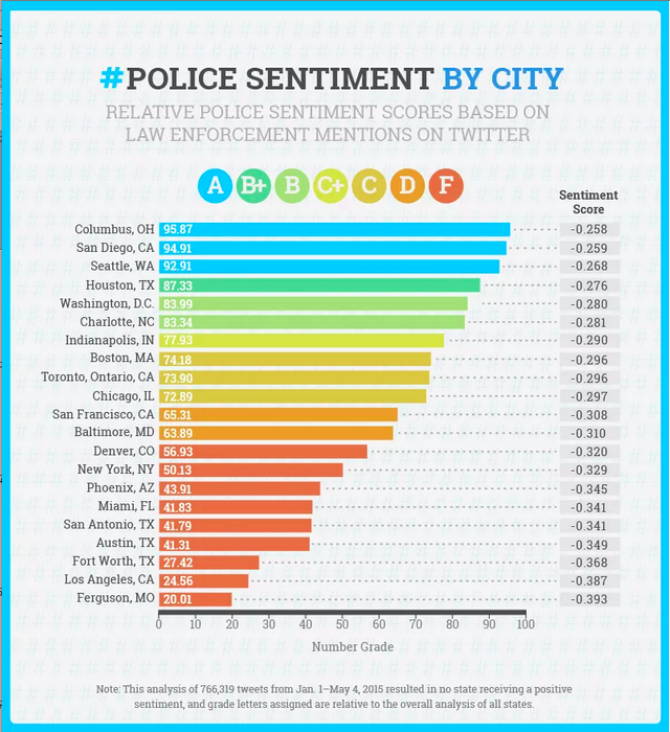

According to a social study, almost nearly half of American’s dislike their police department.
In the new study, a little over 47 percent of Americans gave their police precinct a poor grade of D or F.
The states of Idaho, Arkansas, Missouri, Virginia and Georgia are among those ranked highest in the number of people reporting negative perceptions of police.

Photo Credit: drugabuse.com
The results were gathered from a social media study by drug treatment and awareness site drugabuse.com.
The study found that more than 37 percent of Americans gave their police department an F grade, with the national average being a D.
Grades of A came from North Dakota, West Virginia, New Hampshire, Kansas and Hawaii.
Slightly more than 13 percent of states offered a C grade to police departments, including Texas. This is despite the fact that three Texas cities, San Antonio, Austin and Fort Worth, when looking at data city by city, gave their police department an F grade.
The cities of Boston, San Francisco and Chicago were in the middle with C grades.
The company analyzed over 766,000 tweets about people’s sentiments toward law enforcement in each state.
The state with the most positive perception of police was New Hampshire.
The most negative was Arkansas. The city with the most positive perception of police was Columbus, Ohio, while the one with the most negative was, not surprisingly, Ferguson, Mo.
Other “failing” city police departments with poor ratings included Los Angeles, Miami, Phoenix, New York and Denver.
The reasons for such low scores vary, according to Philip Leaf, a Johns Hopkins University professor whose work is concentrated around preventing youth violence, the overuse of incarceration, trauma, post-traumatic stress disorder and violence in communities.
“If you talk to young people in Baltimore, I don’t think their feelings about police have changed at all in the last five to seven years,” says Leaf. “There has been a negative perception of police in many communities for a long time. There just haven’t been conversations with these young people or in the media about it until recently. There hasn’t been an upsurge of disconnect with the police. With cellphones, there has been documentation of things that people have been talking about for a long time. People haven’t been believed, and now it’s hard not to believe it, if you see it on TV.”
And you know what I say? If you would’ve asked this before the existence of social media, the answer would probably be the same.
The grades would be just as low. The problem is, policing has always been an issue, especially in Black communities.
Since the emergence of social media and the use of mobile and digital technology, we are finally seeing problems that were constantly swept under the rug.
Nonetheless, social media has certainly started a new conversation on policing within our communities.
This study shows America’s policing has a lot of work to do.
Discover more from Unheard Voices Magazine®
Subscribe to get the latest posts sent to your email.











University of Maryland Tennis Club issues public apology after racist imagery sparks backlash

Mississippi Attorney General says officer was justified in shooting that killed 1‑year‑old Kohen Wiley

Police veteran begins rare cancer fight after pleomorphic sarcoma diagnosis

Beloved high school teacher killed in Atlanta murder‑suicide

North Carolina A&T, UNC Greensboro and Bennett students march nearly an hour after campus voting sites removed

VP of Detroit funeral home found dead days after family said mother was mistakenly cremated

Black Aerospace Professionals Development Director Haifa Baptiste dies in Costa Rica flash flood

Mississippi police make second arrest in death of Black woman found hanging from tree

Justice for Nolan Wells Reward Fund raises $300k

California couple welcomes rare mixed triplets weighing 19 pounds total, nearly breaking world record

Woody Shaw’s Avant‑Garde ‘Song of Songs’ returns to vinyl after 50 years through Jazz Dispensary’s Top Shelf Series

Kansas City’s Copper Boyz Ranch provides youth violence‑prevention through horsemanship

Nolan Wells’ family demands ‘thorough’ investigation: “What we’ve been told does not make sense”

Peabo Bryson, Grammy‑winning voice behind two Disney classics, dies at 75

OWN greenlights first-ever ‘Belle Collective’ spinoff Belle Collective: Birmingham





-

 In Memoriam2 weeks ago
Boston rapper Rahim “V Knuckles” Muhammad dies at 46 after fight with brain cancer
-

 In Memoriam2 weeks ago
Major Jewel McDonald, oldest known living man in the U.S., dies at 110
-
 In Memoriam2 weeks ago
Curtis Flowers, Mississippi man wrongfully convicted after being tried for the same killings 6 times, dies at 56
-

 New Jersey1 week ago
New Jersey mom demands answers after 4‑year‑old son died at daycare
-

 Real Voices2 weeks ago
Woman dies after stopping to help trapped driver of flipped car on interstate
-
 Culture2 weeks ago
Black Public Media to premiere “The Morgue Twins,” spotlighting twin NYC mortuary technicians
-

 Health & Wellness2 weeks ago
Teen brother to donate lifesaving bone marrow to younger sister battling sickle cell
-

 Black Excellence2 weeks ago
Happy Birthday! Opal Lee, known as the “Grandmother of Juneteenth”, turns 100