
Social Justice
Martin vs. Malcolm: The Olive Branch and The Arrow
35 years before Biggie vs. Tupac, and generations after Dubois vs. Garvey &Washington, the two leading African American minds, of their generation, engaged in an exhibition of philosophies.

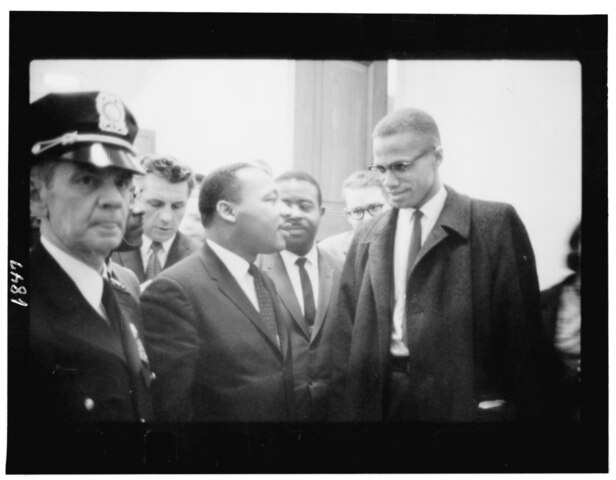

The Olive Branch
He spoke with a vibrato that stirred the souls of a nation. Distorted echoes of his words are still heard today. His short life was a testament to the power of righteous indignation, when combined with love, and the will to persevere. He was a preacher, a scholar, and a father, but the overriding evidence of his actions and decisions shows the true essence of Martin Luther King, Jr.: He was a freedom fighter. The simplification of his message into one of hope and integration can be misleading. The fighter that wrote, “Why We Can’t Wait”, has been reduced to a beggar asking for America’s acceptance. The tree of King’s legacy has been whittled into a crutch of hope for a hobbled nation. As children, American students are spoon fed a simplistic version of King summed up in a few lines at the end of his “I Have A Dream” speech, “I have a dream that one day this nation will rise up and live out the true meaning of its creed: “We hold these truths to be self-evident: that all men are created equal… I have a dream that my four children will one day live in a nation where they will not be judged by the color of their skin but by the content of their character.”
In the same speech Dr. King said, “There will be neither rest nor tranquility in America until the Negro is granted his citizenship rights. The whirlwinds of revolt will continue to shake the foundations of our nation until the bright day of justice emerges”! Does that sound like a weakling to you? A man begging for justice?
“The militancy of these words can easily be relieved if one points out that King rushed to caution black militants against mimicking the hatred of white bigots.”(Dyson) Still, Martin Luther King was not laying down in acceptance of his fate but rather strategically pushing forward his cause.
By being uplifted King as a peaceful symbol of a post-racist utopia King has been marginalized. In turn people lose sight of the fact that he was a radical. Why wouldn’t he be? Martin Luther King Jr. was Christian, and Christ was a radical. Repeatedly, Jesus taught people to believe in and live a spiritual and ethical life based in our essential, inherent goodness. What Jesus promoted was succinct set of spiritual principals and a way of life based upon love, compassion, tolerance, and a strong belief in the importance in giving and of generosity to those in need. King did the same.
Discover more from Unheard Voices Magazine®
Subscribe to get the latest posts sent to your email.








North Carolina A&T, UNC Greensboro and Bennett students march nearly an hour after campus voting sites removed

Family prepares to bury two young Daytona Beach brothers found dead in pond

Xavier Ochsner College of Medicine earns preliminary accreditation, becoming nation’s fifth historically Black medical school

New Jersey woman who outsmarted serial killer and escaped dies at 44

87-year-old civil rights activist brutally beaten and robbed in home invasion

VP of Detroit funeral home found dead days after family said mother was mistakenly cremated

Black Aerospace Professionals Development Director Haifa Baptiste dies in Costa Rica flash flood

Mississippi police make second arrest in death of Black woman found hanging from tree

Sister Betsy Jean Farrakhan, eldest daughter of Minister Louis Farrakhan, dies

Justice for Nolan Wells Reward Fund raises $300k

Woody Shaw’s Avant‑Garde ‘Song of Songs’ returns to vinyl after 50 years through Jazz Dispensary’s Top Shelf Series

Kansas City’s Copper Boyz Ranch provides youth violence‑prevention through horsemanship

Nolan Wells’ family demands ‘thorough’ investigation: “What we’ve been told does not make sense”

Peabo Bryson, Grammy‑winning voice behind two Disney classics, dies at 75

OWN greenlights first-ever ‘Belle Collective’ spinoff Belle Collective: Birmingham





-
 Social Justice2 weeks ago
Justice for Nolan Wells Reward Fund raises $300k
-
 Culture2 weeks ago
Buried history: Documentary uncovers Black slave cemetery hidden under Staten Island shopping center
-
Social Justice2 weeks ago
Atlanta University Center students marched to demand justice for Nolan Wells
-

 Black and Missing2 weeks ago
What happened to Chantel Brooks? Police, family continue to seek answers for woman missing since July
-
 Social Justice2 weeks ago
Nolan Wells’ family, national leaders renew call for federal investigation into teen’s death
-
 In Memoriam1 week ago
Boston rapper Rahim “V Knuckles” Muhammad dies at 46 after fight with brain cancer
-
 Music2 weeks ago
UK soul singer Scarlett Fagan releases video for new single ‘Awaken’
-
 In Memoriam1 week ago
Major Jewel McDonald, oldest known living man in the U.S., dies at 110
Keith Covin
August 29, 2013 at 11:50 pm
Nice article, I am sure that both King and Malcolm must be rolling in their graves to see the preempted negative state of African Americans today.