
Social Justice
Martin vs. Malcolm: The Olive Branch and The Arrow
35 years before Biggie vs. Tupac, and generations after Dubois vs. Garvey &Washington, the two leading African American minds, of their generation, engaged in an exhibition of philosophies.

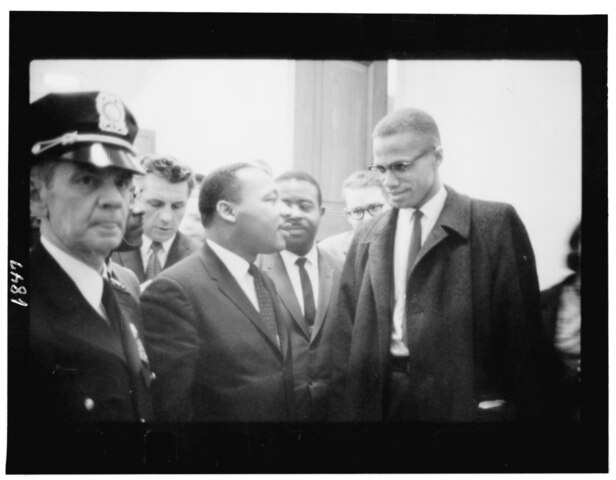

This gangster turned leader inspired fear in white America, and he meant to. He used the Jean Paul Sartre phrase “by any means necessary” to describe the resolve he, and the nation, had. Malcolm’s speech “By Any Means Necessary” was about finding “a solution to the problem that confront(ed) our people”. That problem was oppression. “By Any Means Necessary” was not intended to incite violence but solidarity. What he did assert was “the Afro American’s right to self defense.”
Malcolm’s philosophy was based on his reality, and his reality was a violent one. Therefore he stated that, “The history of unpunished violence against our people clearly indicates that we must be prepared to defend ourselves or we will continue to be a defenseless people at the mercy of a ruthless and violent racist mob.” It is often forgotten that prior to the riots of the 60’s the term “race riot” referred to whites coming into Black neighborhoods and perpetrating acts of violence. These same whites feared that taking their feet off of the necks of Blacks. “The Hate That Hate Produced” could have been called, “The Fear That Fear Caused”, such a title may have even been more accurate.
Regardless of fear and racism Malcolm made a point of stating that “we are Americans”, and that he believed in the viability of The Constitution of the United States. What he did not see was any evidence that that document was being applied to the rights of African Americans. Any law student who has studied the Supreme Court rulings onincorporation, the amendments to The Constitution that related to race, and the ways that those amendments were subverted in the name of states rights, would likely agree with Malcolm’s synopsis of the situation during his lifetime. On October 11, 1963, Malcolm was interviewed at UC Berkley, the first question that he was asked dealt with the “violent philosophy of Black Muslims”, his response to that question only spoke of violence in response to violence. Just as Booker T. Washington had been before him Malcolm was pragmatic. Violence is a staple of the American diet and was consumed in large quantities, and regurgitated on African Americans “without punishment” from this country’s founding until the Civil Rights movement. He was right about America but he was wrong about the role Whites would play in the freedom struggle and his understanding of non-violence as a methodology in that struggle. But he was learning and growing,
Discover more from Unheard Voices Magazine®
Subscribe to get the latest posts sent to your email.








North Carolina A&T, UNC Greensboro and Bennett students march nearly an hour after campus voting sites removed

Family prepares to bury two young Daytona Beach brothers found dead in pond

Xavier Ochsner College of Medicine earns preliminary accreditation, becoming nation’s fifth historically Black medical school

New Jersey woman who outsmarted serial killer and escaped dies at 44

87-year-old civil rights activist brutally beaten and robbed in home invasion

VP of Detroit funeral home found dead days after family said mother was mistakenly cremated

Black Aerospace Professionals Development Director Haifa Baptiste dies in Costa Rica flash flood

Mississippi police make second arrest in death of Black woman found hanging from tree

Sister Betsy Jean Farrakhan, eldest daughter of Minister Louis Farrakhan, dies

Justice for Nolan Wells Reward Fund raises $300k

Woody Shaw’s Avant‑Garde ‘Song of Songs’ returns to vinyl after 50 years through Jazz Dispensary’s Top Shelf Series

Kansas City’s Copper Boyz Ranch provides youth violence‑prevention through horsemanship

Nolan Wells’ family demands ‘thorough’ investigation: “What we’ve been told does not make sense”

Peabo Bryson, Grammy‑winning voice behind two Disney classics, dies at 75

OWN greenlights first-ever ‘Belle Collective’ spinoff Belle Collective: Birmingham





-
 Social Justice2 weeks ago
Justice for Nolan Wells Reward Fund raises $300k
-
 Culture2 weeks ago
Buried history: Documentary uncovers Black slave cemetery hidden under Staten Island shopping center
-
Social Justice2 weeks ago
Atlanta University Center students marched to demand justice for Nolan Wells
-

 Black and Missing2 weeks ago
What happened to Chantel Brooks? Police, family continue to seek answers for woman missing since July
-
 Social Justice2 weeks ago
Nolan Wells’ family, national leaders renew call for federal investigation into teen’s death
-
 In Memoriam1 week ago
Boston rapper Rahim “V Knuckles” Muhammad dies at 46 after fight with brain cancer
-

 Music2 weeks ago
UK soul singer Scarlett Fagan releases video for new single ‘Awaken’
-
 In Memoriam1 week ago
Major Jewel McDonald, oldest known living man in the U.S., dies at 110
Keith Covin
August 29, 2013 at 11:50 pm
Nice article, I am sure that both King and Malcolm must be rolling in their graves to see the preempted negative state of African Americans today.