
Social Justice
Martin vs. Malcolm: The Olive Branch and The Arrow
35 years before Biggie vs. Tupac, and generations after Dubois vs. Garvey &Washington, the two leading African American minds, of their generation, engaged in an exhibition of philosophies.

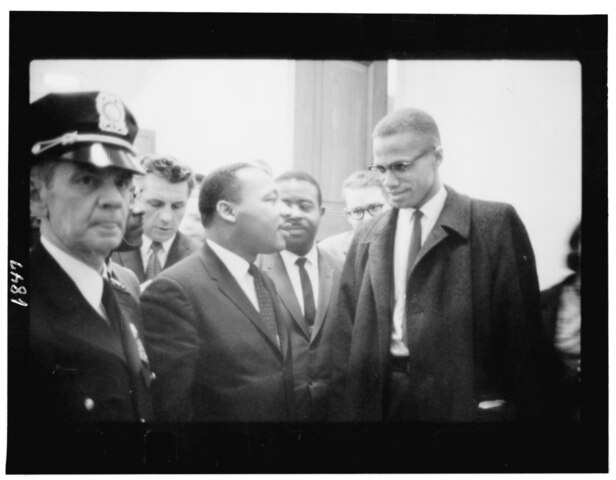

This gangster turned leader inspired fear in white America, and he meant to. He used the Jean Paul Sartre phrase “by any means necessary” to describe the resolve he, and the nation, had. Malcolm’s speech “By Any Means Necessary” was about finding “a solution to the problem that confront(ed) our people”. That problem was oppression. “By Any Means Necessary” was not intended to incite violence but solidarity. What he did assert was “the Afro American’s right to self defense.”
Malcolm’s philosophy was based on his reality, and his reality was a violent one. Therefore he stated that, “The history of unpunished violence against our people clearly indicates that we must be prepared to defend ourselves or we will continue to be a defenseless people at the mercy of a ruthless and violent racist mob.” It is often forgotten that prior to the riots of the 60’s the term “race riot” referred to whites coming into Black neighborhoods and perpetrating acts of violence. These same whites feared that taking their feet off of the necks of Blacks. “The Hate That Hate Produced” could have been called, “The Fear That Fear Caused”, such a title may have even been more accurate.
Regardless of fear and racism Malcolm made a point of stating that “we are Americans”, and that he believed in the viability of The Constitution of the United States. What he did not see was any evidence that that document was being applied to the rights of African Americans. Any law student who has studied the Supreme Court rulings onincorporation, the amendments to The Constitution that related to race, and the ways that those amendments were subverted in the name of states rights, would likely agree with Malcolm’s synopsis of the situation during his lifetime. On October 11, 1963, Malcolm was interviewed at UC Berkley, the first question that he was asked dealt with the “violent philosophy of Black Muslims”, his response to that question only spoke of violence in response to violence. Just as Booker T. Washington had been before him Malcolm was pragmatic. Violence is a staple of the American diet and was consumed in large quantities, and regurgitated on African Americans “without punishment” from this country’s founding until the Civil Rights movement. He was right about America but he was wrong about the role Whites would play in the freedom struggle and his understanding of non-violence as a methodology in that struggle. But he was learning and growing,
Real stories. Real impact. Straight to your inbox. Join thousands others. Click here to subscribe to our newsletter today!
Want to tell your story, send a news tip or report a correction? Contact us at [email protected]
Follow us on Facebook, X, TikTok, Instagram, News Break
Discover more from Unheard Voices Magazine®
Subscribe to get the latest posts sent to your email.










Oyo Nyimba, world’s youngest reigning monarch, dies at 34

Remembering Dolly Parton

Target faces renewed backlash over offensive Halloween costume with ‘Minstrel Show Features’

Actor Samuel Monroe Jr., known for ‘Menace II Society,’ dies at 52

Laundry owner offers free wash‑and‑fold service to Gary storm victims

Black woman found hanging from tree behind vacant home in Jackson, Mississippi

Woman jailed after refusal to sign over family’s 1,300 acres of Mississippi land claim

Ghana’s tallest man, Sulemana Abdul Samed, passes away at 33

Pastor Jamal Bryant announces national prayer rally for Nolan Wells

Engineer defends enhanced audio of Sea Tow call at center of Nolan Wells case

Woody Shaw’s Avant‑Garde ‘Song of Songs’ returns to vinyl after 50 years through Jazz Dispensary’s Top Shelf Series

Kansas City’s Copper Boyz Ranch provides youth violence‑prevention through horsemanship

Nolan Wells’ family demands ‘thorough’ investigation: “What we’ve been told does not make sense”

Peabo Bryson, Grammy‑winning voice behind two Disney classics, dies at 75

OWN greenlights first-ever ‘Belle Collective’ spinoff Belle Collective: Birmingham





-

 Real Voices2 weeks ago
Viral Waffle House employee says the company fired him
-
 In Memoriam2 weeks ago
In Memoriam: Jason Arday, PhD
-

 Social Justice6 days ago
Sean Grayson, former Illinois Deputy convicted in Sonya Massey killing, dies at 32
-
 Black and Missing1 week ago
New York woman vanishes in Las Vegas; Family receives texts asking for cash and bitcoin
-

 Sports1 week ago
Former NFL linebacker Tae Crowder launches GoFundMe after losing life savings in alleged fraud scheme
-
 Black and Missing1 week ago
NYC woman who went missing in Las Vegas found dead, family confirms
-
 Real Voices1 week ago
More than $40,000 raised for father who drowned saving two strangers from rip current at Myrtle Beach
-
 In Memoriam5 days ago
Keith Caesar, Bronx hip-hop groundbreaker and member of Funky 4 + 1, dies at 64
Keith Covin
August 29, 2013 at 11:50 pm
Nice article, I am sure that both King and Malcolm must be rolling in their graves to see the preempted negative state of African Americans today.